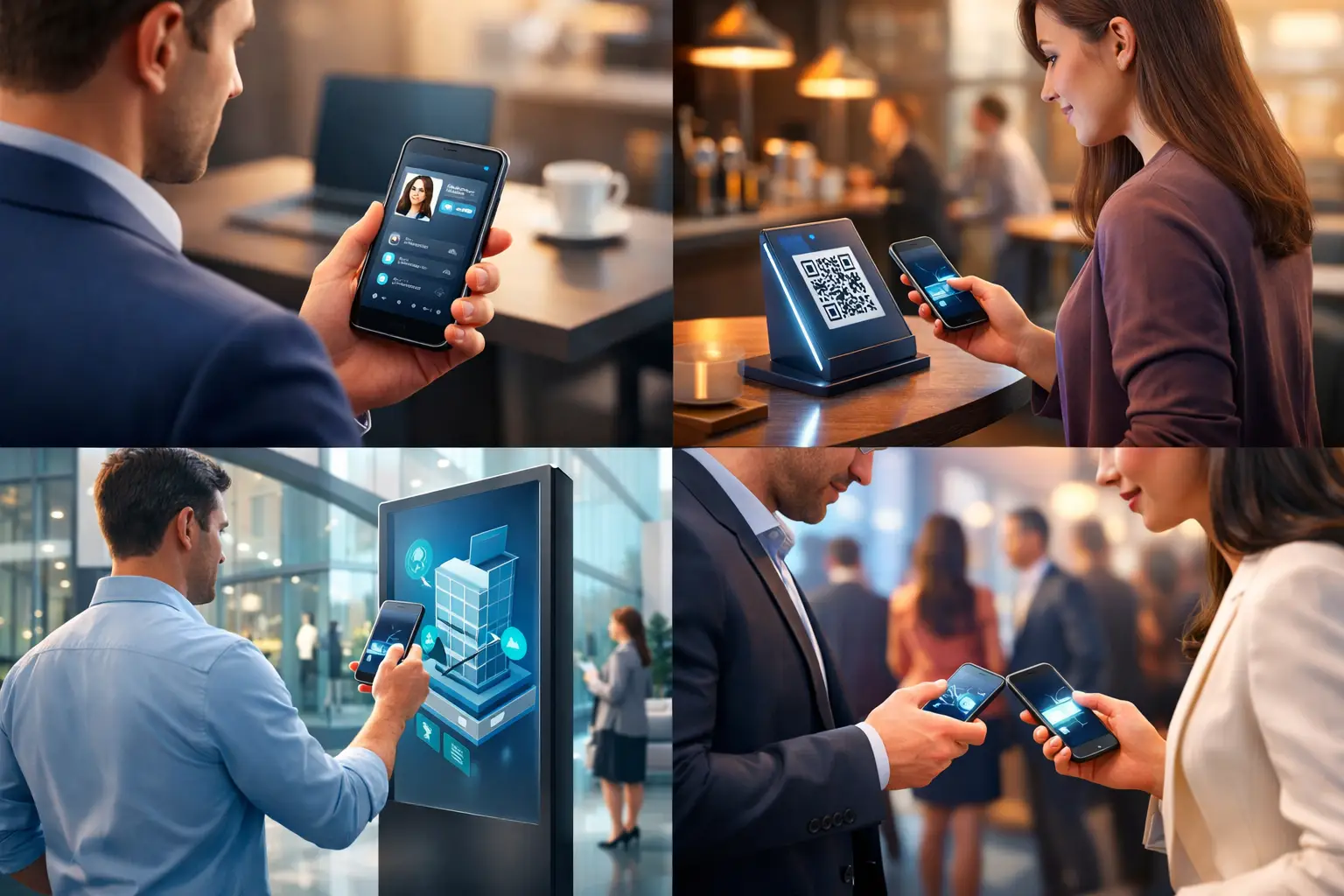
You meet someone at a conference, trade details in a crowded hallway, and promise to follow up. By the next day, the paper card is buried in a bag, the saved contact has no context, and the moment is already cooling off. That is the real answer to why use QR profiles for networking: they reduce friction at the exact point where opportunities are usually lost.
A QR profile gives people one fast scan to access your live professional identity. Instead of handing over static information that goes out of date, you share a profile that can include your role, company details, contact options, social channels, portfolio, booking links, and other business actions in one place. or professionals, exhibitors, and teams that rely on high-volume interactions, that shift matters.
Why use QR profiles for networking in real business settings
Traditional networking tools were built for a slower pace. Paper business cards assume people will manually type in details later. ven standard contact sharing assumes you only need a phone number and email. That is not how modern networking works.
Most business relationships start with context, not just contact information. Someone wants to remember where they met you, what you do, and what the next step should be. A QR profile makes that easier because it can present the right information immediately, without forcing the other person to search for your LinkedIn, website, scheduling page, or company profile after the conversation ends.
This is especially useful in environments where time is short and attention is divided. At events, trade shows, executive meetings, office lobbies, and client-facing locations, every extra step lowers the chance of follow-through. The more direct the interaction, the better the conversion from introduction to action.
Static cards create friction. QR profiles remove it.
Paper cards still have a place in some industries, but they come with obvious limits. They can be lost, damaged, or outdated. They cannot adapt to different audiences. They also do not tell you what the recipient did next, if anything.
QR profiles solve a more practical problem than most people realize. They shorten the distance between meeting someone and taking action. That action might be saving a contact, opening a proposal, viewing product information, booking a meeting, or starting a chat. Instead of hoping a prospect remembers you later, you make the next step available right away.
That matters because networking is rarely about the initial exchange. It is about what happens in the minutes and days after it.
They keep your information current
One of the strongest reasons to use a QR profile is that your identity stays live. If your title changes, your phone number updates, or you want to redirect people to a new campaign or event page, you can update the profile without reprinting anything.
or executives, consultants, sales teams, and public-facing professionals, this is a practical upgrade. You do not need to keep replacing cards or worrying that an old version is still circulating. The profile remains current, and every scan points to the latest information.
They support more than one audience
Not every contact needs the same next step. A potential client may need a booking link. A media contact may need your press kit. A partner may want your company overview. A recruiter may want your portfolio.
A QR profile handles this better than a basic card because it can hold multiple pathways without making the interaction messy. You give one scan, and the recipient chooses what is relevant. That creates a cleaner networking experience while keeping your outreach flexible.
QR profiles make first impressions more useful
A good first impression is not just about looking modern. It is about making the interaction easier for the other person.
When someone scans your QR profile, they do not have to ask for spelling, search for your company later, or guess which channel you actually use. The path is clear. That signals professionalism in a very practical way.
There is also a branding advantage. A well-designed digital identity feels more intentional than handing over a card with limited space and no interactivity. It gives you room to present your value clearly without relying on a rushed verbal explanation.
or people who network across markets, multilingual access can also make a real difference. If your profile adapts to the user’s device language, you remove another barrier and make the interaction more accessible from the start.
Why use QR profiles for networking at conferences and events
Conferences are where the gap between interest and follow-up becomes painfully obvious. You may meet dozens of valuable contacts in one day, but most of those introductions compete for attention once the event ends.
A QR profile improves that process because it captures attention while the conversation is still active. Instead of saying, “I’ll send you the details,” you can provide the details on the spot. Instead of sharing a card that may never be revisited, you share a dynamic profile that leads directly to action.
or exhibitors, this is even more important. Booth conversations are fast. Attendees are moving. Teams need a way to connect without slowing down the interaction. A QR profile can help bridge the space between casual booth traffic and qualified lead engagement.
There is also a measurement advantage. Digital interactions are easier to track than paper exchanges. While not every networking scenario needs analytics, event teams and sales organizations often benefit from knowing which profiles were scanned, when interest peaked, and where follow-up is likely to matter most.
QR profiles are better for teams, not just individuals
A common mistake is treating QR networking as a personal branding tool only. In reality, it is often more valuable at the team and company level.
Sales organizations can standardize how representatives share contact information. vent staff can route people to the right department without confusion. ront-desk teams can direct visitors, tenants, or guests to relevant digital information with one scan. In each case, the QR profile is doing more than replacing a business card. It is organizing the interaction.
That is where a platform approach becomes more useful than a standalone QR generator. If a business wants consistent branding, live updates, role-based profiles, and use across events, offices, and client engagement, disconnected tools start to create their own friction.
or organizations looking to modernize how they present people and services, a digital identity solution like Your Digital Identity gives teams a more controlled and adaptable way to network.
There are trade-offs, and context still matters
QR profiles are not magic. They work best when the environment supports quick scanning and mobile engagement. In some formal settings, a printed card may still feel expected. In low-tech environments, some people may hesitate to scan anything unfamiliar. And if the profile itself is poorly designed, the convenience disappears fast.
That is why the quality of the experience matters. A QR profile should load quickly, look professional, and make the next step obvious. Too many buttons, weak messaging, or outdated information can hurt just as much as an old paper card.
It also depends on your goal. If you only need to share a phone number once in a while, a QR profile may be more than you need. But if networking is part of lead generation, event engagement, client service, executive visibility, or business development, the value becomes much clearer.
The real benefit is momentum
The strongest case for QR profiles is not that they look innovative. It is that they help preserve momentum.
Business opportunities are often won or lost in small moments. A fast scan. A saved contact. A booked meeting before the conversation fades. A product page opened while interest is still high. These are simple actions, but they shape whether networking actually produces results.
That is why use qr profiles for networking is the right question to ask now. The answer is not about replacing one format with another for the sake of change. It is about making every introduction easier to continue.
If your networking process still depends on static details, delayed follow-up, and scattered links, you are leaving too much to chance. A QR profile gives your contacts a clearer path, and that usually means more conversations turn into something useful.
The smartest networking tool is not the one that says the most. It is the one that makes the next step easy enough to happen.