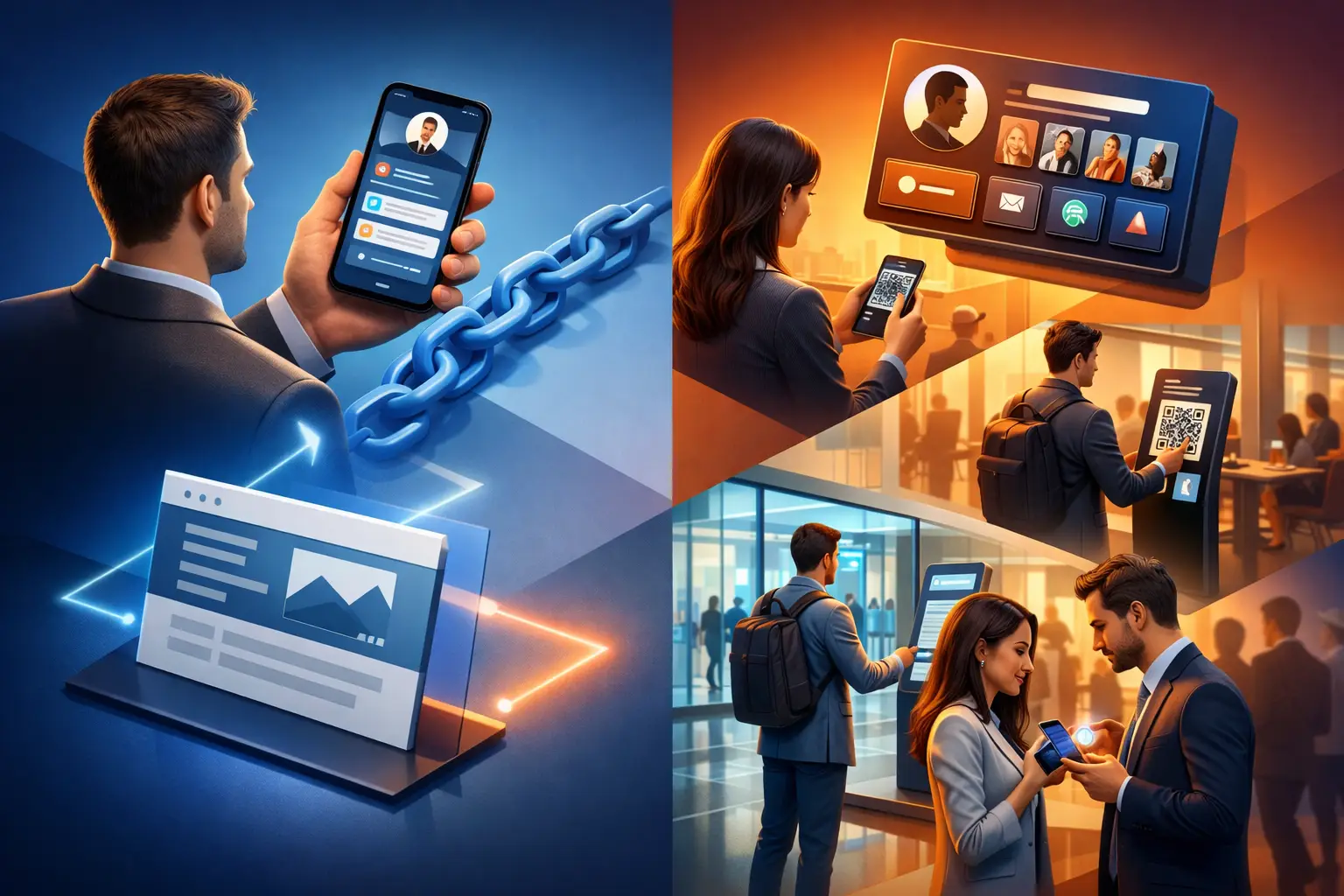
A missed lead often starts with something small: an outdated link in a bio, a PD business card no one can save, or a QR code that points to information that changed last week. That is where static links vs dynamic profile pages becomes a real business decision, not just a formatting preference.
or professionals, event teams, and businesses that rely on fast follow-up, the difference is simple. Static links send people to one fixed destination. Dynamic profile pages give you a live, editable destination that can change as your goals, audience, and context change. The right choice depends on how often your information changes, how many touchpoints you manage, and whether you want a link to simply exist or actively perform.
What static links do well
Static links are straightforward. You copy a URL, paste it into an email signature, social profile, presentation, or QR code, and people land on a single page. If you want to send someone to your homepage, booking page, restaurant menu, event registration form, or contact page, a static link can do that with almost no setup.
That simplicity is the main advantage. Static links are easy to understand, easy to distribute, and useful when the destination rarely changes. If you run a campaign with one clear call to action, a fixed link can keep things clean.
They also fit environments where speed matters more than flexibility. A speaker sharing a registration link, a retailer promoting one seasonal offer, or a clinic directing patients to one scheduling page may not need anything more complex.
The limitation shows up later. If the content behind the link changes, the user journey often breaks. You may need to replace the link everywhere it appears, regenerate printed materials, update QR placements, or accept that some traffic will continue landing on old information.
Why dynamic profile pages are different
Dynamic profile pages are built for living information. Instead of sending someone to one fixed destination, you send them to a branded profile that can hold multiple actions, update in real time, and adapt to the audience at the moment they arrive.
That matters when your contact details, service options, event schedule, office instructions, or lead capture flow changes often. A dynamic page lets you update the experience without changing the QR code, the card, or the shared link itself.
This is why dynamic profile pages have become more useful than the classic link-in-bio format. They are not just a container for links. They can function as a digital identity layer, a sales touchpoint, a visitor guide, or an event engagement tool depending on the use case.
or professionals using smart QR business cards, this shift is especially clear. A modern digital identity should not force you to resend a new link every time your title changes, your meeting link moves, or you want to feature a new service. A live profile handles those changes in one place. OneContact applies this model to digital identity with continuously updated shareable profiles built for real business interactions.
Static links vs dynamic profile pages for real business use
or professionals and executives
If you are a consultant, executive, public figure, or sales leader, static links can feel limiting fast. Your audience may need different things at different times: your contact details, social channels, latest media, booking options, portfolio, or speaking request form. Sending a single static URL usually forces you to prioritize one path and ignore the rest.
Dynamic profile pages solve that by turning one share point into a controlled digital presence. You can update content without replacing the link, present a more premium experience, and reduce the friction that comes from scattered online assets. That is especially useful when networking in person through QR codes or smart business cards, where every scan should create a next step, not a dead end.
or conferences and events
vents move quickly, which makes static links risky. Session details change. Speakers update. Registration statuses shift. xhibitors want lead capture, not just page visits. Attendees need directions, agendas, and contact options in one place.
In that setting, dynamic profile pages give organizers and exhibitors much better control. Instead of asking people to search through emails, download generic apps, or scan different codes for different needs, one live profile can centralize the event experience. That means fewer missed interactions and a cleaner path from registration to participation to follow-up.
The same logic applies on the show floor. An exhibitor using a static link might send visitors to a general website where interest gets lost. A dynamic profile page can offer product details, meeting booking, lead capture, and direct contact in one scan.
or office buildings and tenant communication
Office environments are another place where fixed links fall short. Visitor information, parking instructions, tenant directories, and building notices change frequently. A printed QR code tied to a static page can become outdated almost immediately.
A dynamic profile page keeps the physical touchpoint useful. Building managers and tenant companies can update guidance in real time while keeping the same scan point active. That improves the visitor experience and reduces confusion at arrival, especially in multilingual environments where accessibility and clarity matter.
or local businesses and service providers
Restaurants, clinics, real estate agencies, and retail teams often need more than one customer action. A customer may want to call, book, review, get directions, browse services, or message the business. A static link usually supports one of those actions at a time.
A dynamic profile page supports the actual decision flow. It gives customers choices without making them search, and it allows the business to update promotions, hours, staff details, or service availability without reprinting materials.
The trade-off: simplicity vs control
This is not a case where dynamic automatically means better in every situation. Static links still make sense when the destination is stable and the goal is singular. If you only need to send traffic to one landing page for a short campaign, a static link is often enough.
But if your business depends on ongoing engagement, repeat scans, or multiple user actions, static links create hidden operational work. You spend time updating assets, correcting outdated information, and patching disconnected experiences. The simpler tool starts becoming the less efficient one.
Dynamic profile pages require more intentional setup at the start. You need to think about structure, branding, calls to action, and what users should do next. That extra planning pays off when the page becomes a reusable business asset instead of a one-off link.
What to evaluate before you choose
The best choice comes down to how your organization works. If your information changes monthly, weekly, or even daily, dynamic will usually outperform static. If you rely on printed QR codes, in-person networking, event foot traffic, or visitor access points, dynamic becomes even more valuable because the physical touchpoint stays the same while the digital experience evolves.
You should also consider whether you need visibility into engagement. Static links can send traffic, but they are often weak at creating a structured interaction. Dynamic profile pages are better suited to measurable actions such as saving contact details, starting a conversation, registering interest, or navigating to the next step.
Brand consistency matters too. A dynamic page can present a cleaner and more professional experience than sending users across a patchwork of disconnected destinations. or companies trying to modernize customer interaction, that difference is noticeable.
Static links vs dynamic profile pages in the next phase of digital identity
The bigger shift here is not about links alone. It is about whether your digital presence is passive or active. Static links belong to a web model where information sits still and users do the work. Dynamic profile pages reflect a more useful model where the business shapes the interaction, updates in real time, and removes friction from every touchpoint.
That is why digital identity, event engagement, and workplace communication are increasingly moving toward live, adaptable assets. The old approach assumes your audience will tolerate broken paths, outdated details, and too many steps. Most will not. They will simply move on.
If you want each scan, share, or profile visit to create a stronger next action, a dynamic page gives you more room to do it well. And if your organization serves different audiences across networking, events, or physical locations, a flexible platform becomes less of a nice extra and more of a practical operating advantage.
A static link can send someone somewhere. A dynamic profile page can help them do something useful when they get there. That difference is where better engagement usually starts.