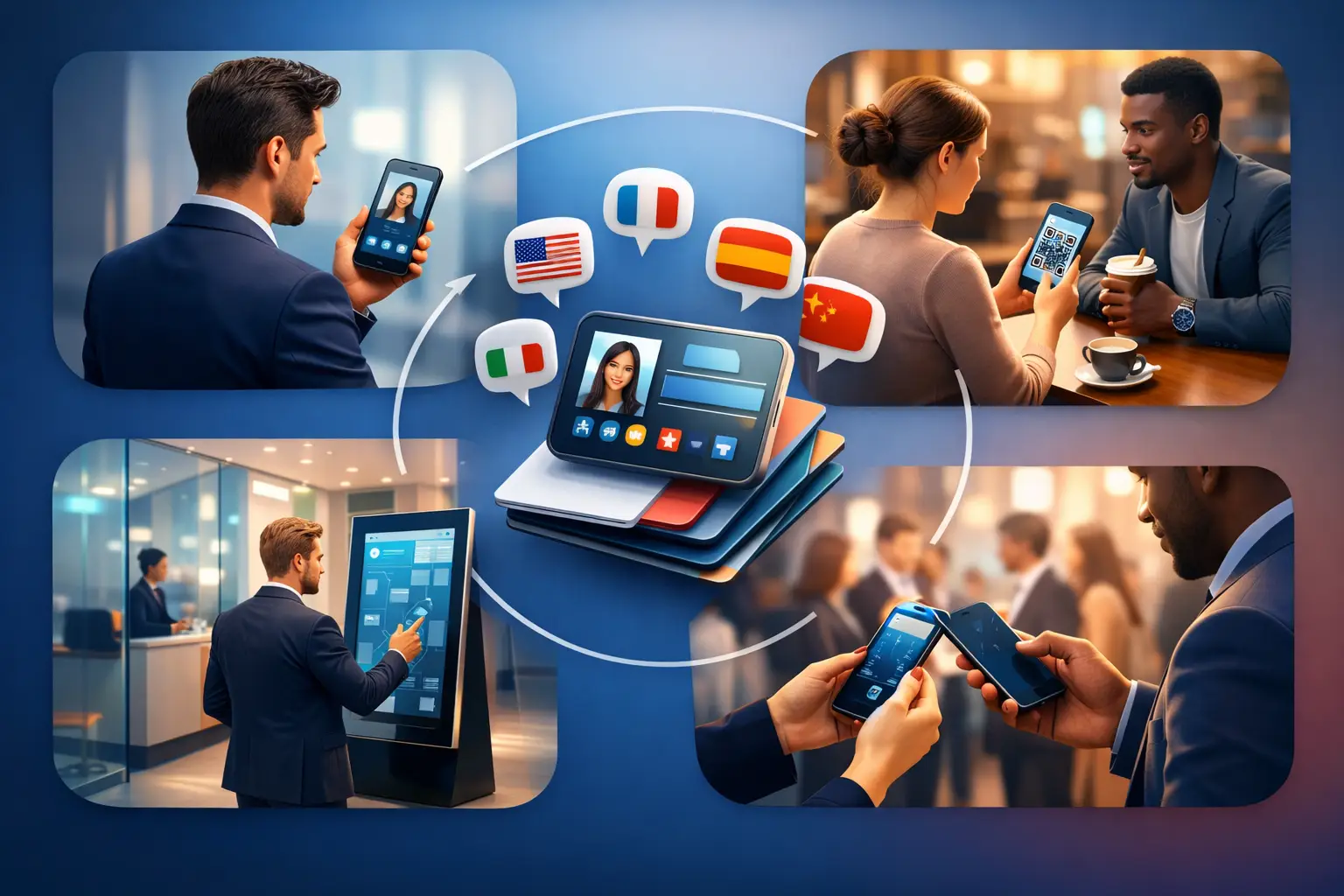
A promising conversation can stall for a surprisingly small reason: the other person cannot quickly read your contact details, understand your role, or find the right next step. That is exactly where a multilingual digital business card changes the outcome. Instead of handing over a static card and hoping for a follow-up, you give each contact a live, mobile-friendly profile that adapts to how they actually engage.
or companies working across regions, languages are not a branding detail. They affect conversion. A prospect at a trade show, a visitor in an office tower, or a partner meeting your executive for the first time will move faster when the experience feels clear and local from the first scan.
What makes a multilingual digital business card different
A standard digital card usually solves one problem: it replaces paper with a link or QR code. A multilingual digital business card does more than that. It presents the same professional identity in a format that is easier to understand across different audiences, devices, and contexts.
That matters because most business interactions are not happening in ideal conditions. They happen in busy lobbies, on crowded event floors, between meetings, and during quick introductions. People are making snap decisions. If they have to translate your title, search for your right number, or guess which link matters, you create friction at the exact moment you should be building momentum.
A well-designed multilingual card reduces that friction by serving the right language automatically or giving users a simple way to switch. The best versions also keep information live, so if your phone number, meeting link, regional office details, or campaign CTA changes, the card updates everywhere without reprinting anything.
Why language support affects lead quality
Many teams think of translation as a courtesy feature. In practice, it is often a qualification feature. When someone can read your offering immediately, they are more likely to take the next action correctly - save your details, book a meeting, message the right team, or send the inquiry to procurement instead of customer support.
That is especially true for four groups.
Sales teams meeting international buyers need every scan to carry forward into the CRM with context, not confusion. vent organizers and exhibitors need attendee interactions to continue after the booth visit, not disappear in a pile of unread cards. Companies in office buildings need visitors, tenants, and service providers to get accurate contact and navigation details without asking the front desk for help. xecutives and public-facing professionals need one polished identity that works whether the audience speaks nglish, Hebrew, or another supported language.
In each case, the real gain is not just readability. It is response rate.
Where a multilingual digital business card delivers the most value
Conferences and trade shows
vents expose the weakness of paper cards quickly. You collect dozens of contacts, but the context disappears. Attendees forget who you were, what you offered, and which product page to visit. A multilingual digital business card keeps the follow-up path visible.
When someone scans your card at a booth, they can see your profile in their preferred language, save your contact instantly, and move to the next action while interest is still high. That next action might be scheduling a demo, opening a product page, or sending a direct message. or exhibitors and organizers, this creates a cleaner bridge between in-person engagement and measurable pipeline.
If events are a core channel for your business, a connected platform matters even more. OneContact supports this kind of interaction across digital identity and event engagement, which is why its smart QR business card offering at Your Digital Identity fits naturally into a broader lead capture strategy.
Office buildings and tenant environments
In commercial real estate and multi-tenant offices, business identity is part of the visitor experience. A guest arriving for a meeting may need building access instructions, parking information, floor location, and a direct way to contact the host. If those details are only available in one language or spread across separate systems, delays follow.
A multilingual card can act as a lightweight front door. Visitors scan once and get the right information in a language they understand. Tenant companies can share employee profiles, office contact routes, and live updates without sending separate emails or printed directions. Property managers benefit too, because fewer routine questions need manual handling.
Global client-facing professionals
or executives, consultants, public figures, and relationship-driven roles, first impressions are increasingly digital. The old model was simple: exchange cards, then email later. The new model is immediate. People expect to scan, view, save, and act.
A multilingual digital business card supports that expectation while keeping the presentation premium. It can consolidate contact details, social channels, scheduling links, media appearances, booking requests, and department-specific CTAs into one controlled identity. That is useful when your audience is diverse and your time is limited.
What to look for in a multilingual digital business card
Language support alone is not enough. Plenty of tools can display translated text, but not all of them help businesses operate better.
Start with device-language detection or simple language switching. If users have to search for the right version, you lose some of the benefit. Then look at update control. A digital card should be a live asset, not a static webpage you forget to maintain. If your information changes often, central management is essential.
The next factor is context. Different users need different outcomes. A sales rep may need a lead form and CRM capture. A tenant company may need office arrival details and direct chat. A public-facing executive may need booking links and media contacts. The strongest platforms are built around these use cases rather than forcing everyone into the same generic profile.
Analytics also matter, but here the trade-off is worth stating clearly. More tracking can improve lead visibility, yet too much complexity can slow adoption internally. The goal is not to create another dashboard your team ignores. The goal is to see which scans become conversations and where engagement drops off.
The trade-offs businesses should consider
A multilingual digital business card is not automatically the right fit just because your company works internationally. It depends on how often your teams meet people in person, how varied your audiences are, and whether follow-up speed affects revenue.
If your business is highly local and relationship cycles are long, the language layer may be less urgent than strong profile design or faster contact capture. If your team rarely updates contact details, live editing may matter less than branding consistency. And if your organization operates in regulated environments, approval workflows for content changes may influence which platform you choose.
There is also a practical adoption question. The best card in the world does not help if employees do not use it. Simplicity matters. The sharing method should feel natural, whether that is QR, NC, wallet save, or direct link. Training should take minutes, not weeks.
How to make your multilingual digital business card work harder
The strongest results come when the card is treated as part of your engagement flow, not as a standalone contact page.
Keep the profile focused. Give people one or two clear next actions based on role and context. An event rep might offer "Book a follow-up" and "View product overview." A building tenant might offer "Call office" and "Open visitor instructions." A senior executive might offer "Save contact" and "Request meeting."
Write copy for real-world scanning moments. Short labels perform better than internal jargon. Localize titles and actions in a way that makes sense to the audience, not just word-for-word translation. Review the mobile experience on different devices, because what feels clear in desktop editing mode can feel crowded on a phone.
inally, keep ownership centralized. Marketing, operations, or admin teams should be able to maintain brand standards while giving individuals enough flexibility to personalize their profile. That balance is where digital identity starts to scale.
Why this shift is bigger than networking
The real value of a multilingual digital business card is not that it looks modern. It is that it turns one business interaction into a live digital touchpoint. Instead of giving someone a dead end, you give them a current, measurable, action-ready experience.
That shift matters across sales, events, workplaces, and executive visibility because every one of those environments depends on reducing friction. The business that communicates clearly, in the right language, with the right next step usually wins the follow-up.