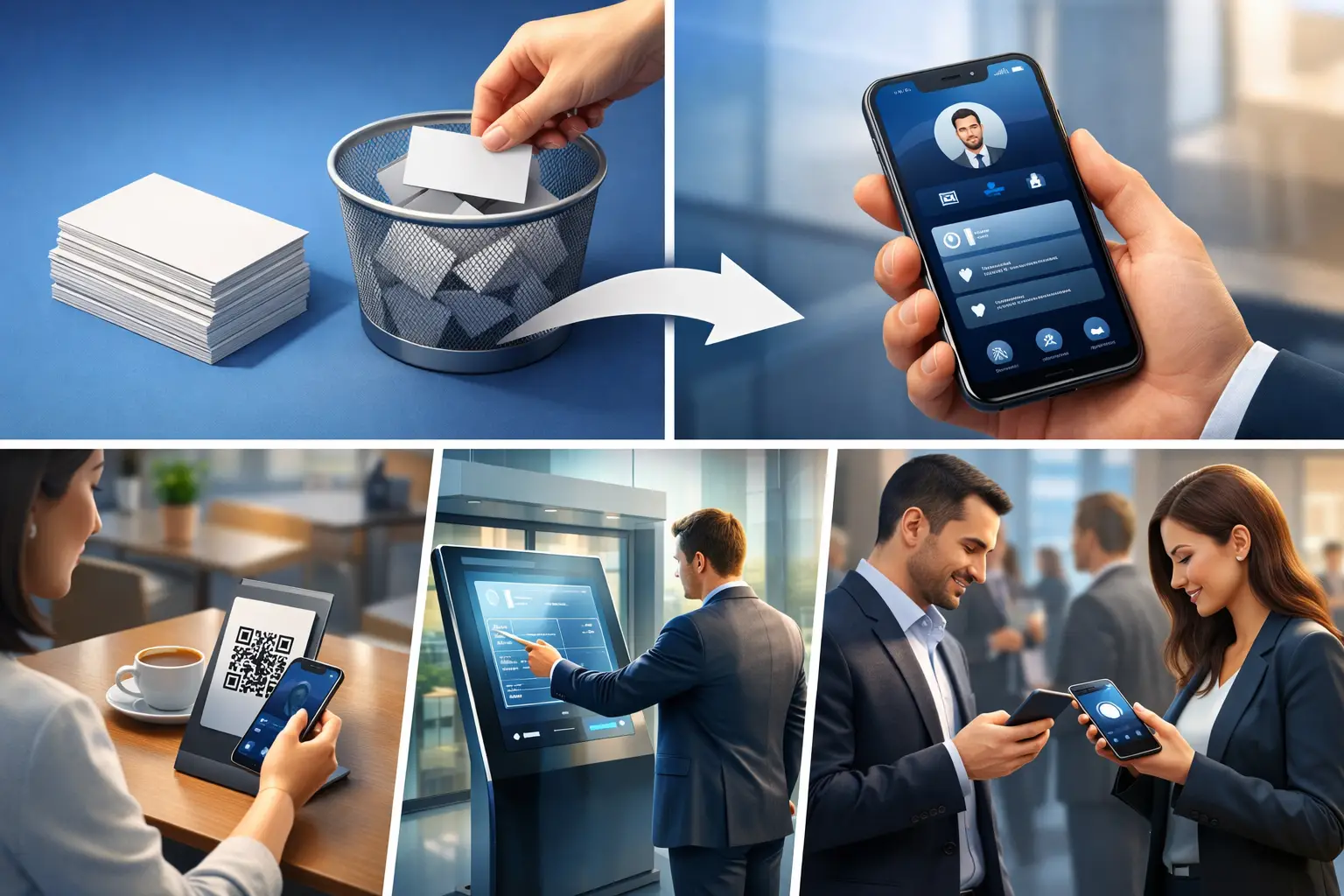
You can tell a lot about a sales process by what happens right after a handshake. If the next step is someone stuffing a paper card into a pocket, hoping it survives the day, the process is already leaking opportunities. That is why more teams are asking how to replace paper business cards with something faster, easier to update, and far more useful after the first meeting.
The short answer is not just "go digital." The real shift is from static contact sharing to active engagement. A paper card gives someone a name, a title, and maybe an email address. A modern digital identity can give them the right contact details, booking links, company information, social channels, product pages, and a clear next step - all from one scan.
Why paper business cards stop working so quickly
Paper cards still feel familiar, but familiarity is not the same as effectiveness. The biggest issue is that they freeze your information in time. Change your role, phone number, website, or meeting link, and every printed card becomes outdated.
They also create friction at the worst possible moment. After an event, trade show, office visit, or client introduction, the other person has to manually type in your details or remember to follow up later. Many do not. ven when they mean to, paper gets lost, damaged, or buried under a stack of other cards from the same day.
or companies that care about lead quality and measurable outcomes, paper has another weakness. It tells you nothing. You do not know who saved your details, who visited your profile, or which conversations turned into action. That makes paper business cards a poor fit for modern sales teams, event exhibitors, executives, and customer-facing staff.
How to replace paper business cards without losing the personal touch
The best replacement keeps the speed and simplicity of handing over a card, while improving everything that happens next. In practice, that usually means a digital card or smart QR business card connected to a live profile.
Instead of printing fixed information, you create a digital identity that can be shared in person, by phone, through email signatures, at events, or on signage. Someone scans a QR code or taps a smart card and lands on a profile built to help them act immediately. They can save your contact, visit your company page, book a meeting, or send a message without retyping anything.
That matters because replacing paper is not just about format. It is about removing friction from the follow-up. If a contact can move from introduction to action in seconds, your networking becomes more productive.
or professionals and teams that want a practical place to start, a smart digital business card platform such as OneContact gives you a live, customizable profile designed for real business interactions. It supports dynamic sharing, updated contact details, and QR-based access built for modern lead generation.
What a strong digital replacement should include
Not every digital business card solves the real problem. Some are little more than a basic online contact page. If you are serious about how to replace paper business cards, focus on functionality that improves both the first interaction and the follow-up.
A good setup should let you update details in real time. That is non-negotiable. Your phone number, title, meeting link, or call-to-action should never require a reprint.
It should also support more than contact information. Different roles need different next steps. A consultant may want a booking button. A sales rep may want product links and a lead capture flow. A public-facing executive may want media channels, speaking inquiries, and social profiles in one place.
Mobile usability is just as important. If the experience is cluttered or slow on a phone, you are replacing one kind of friction with another. The person scanning your code should immediately understand who you are and what to do next.
or organizations with international audiences, language support can make a real difference. A digital profile that adapts to the visitor's device language is more useful than a one-language paper card, especially at conferences, in hospitality, or in global business development.
Where digital cards create the biggest advantage
The shift away from paper is useful almost everywhere, but some settings make the value obvious very quickly.
Sales meetings and business development
In a one-to-one meeting, a digital card turns a basic exchange into a live contact point. Instead of saying, "Here is my card," you can say, "Scan this and book time with me when you're ready." That small change improves the odds of follow-through because the next step is already built in.
or teams, there is also a brand control benefit. veryone can share a consistent profile format instead of distributing different card designs, outdated titles, or inconsistent messaging.
Conferences and trade shows
This is where paper cards fail fast. High-volume networking creates stacks of cards with very little context. xhibitors collect them, attendees misplace them, and follow-up slows down.
A digital alternative works better because it can connect identity sharing with event engagement. At a booth, for example, a smart QR interaction can direct visitors to your digital profile, collect lead information, and support faster CRM handoff. That reduces the gap between a booth conversation and a qualified sales opportunity.
Office buildings and visitor interactions
In office environments, paper cards are often still used at reception desks, tenant offices, and visitor meetings. They are not ideal for navigation, building communication, or access to up-to-date office details.
A digital identity approach fits better in modern workplaces because it can do more than identify a person. It can guide visitors, share tenant contact points, and connect physical arrival with live business communication. That is especially useful in multi-tenant buildings where clarity and speed matter.
How to roll out the change inside a company
If you are replacing paper across a team, the rollout matters. The most effective approach is to start with a clear business goal, not just a design decision. Ask what you want the card replacement to improve. aster follow-up, better lead capture, stronger branding, less printing waste, and easier updates are all valid goals, but the setup should match the priority.
Then decide what each role needs on their digital profile. Senior executives may need a polished identity page with media and contact options. Sales teams may need booking links, brochures, and campaign tracking. vent staff may need profiles tailored to exhibitor engagement. The more aligned the profile is to the actual job, the better the results.
Training should stay simple. People adopt new tools faster when the action is obvious. Show them how to share the QR code, when to use it, and what to say in a real conversation. A digital card should feel easier than paper, not more technical.
It also helps to retire paper intentionally instead of slowly drifting away from it. If teams keep both formats forever, they often fall back to the old habit. Set a timeline, define the use cases, and make the digital option the default.
The trade-offs to think about
There are clear benefits, but this is not a case where one format is perfect in every situation. Some people still prefer the familiarity of paper, especially in traditional industries or informal local networking groups. In those cases, a hybrid period may make sense.
There is also a quality gap between digital tools. A generic profile page with no brand consistency, no analytics, and no useful action buttons may not outperform paper by much. The replacement only works if it is designed around real business outcomes.
Privacy and data handling matter too. If your digital identity tool captures lead information or interaction data, your organization should understand how that information is stored and used. or enterprise teams, governance is part of adoption.
The good news is that these trade-offs are manageable when the platform is built for business use rather than casual link sharing.
How to know the switch is working
A successful move away from paper is easy to spot. More contacts take action right away. ewer leads disappear after events. Teams spend less time reprinting cards and correcting outdated information. Brand presentation becomes more consistent, and follow-up gets faster.
You may also notice a less obvious improvement. Conversations become more focused because the card is no longer the end of the interaction. It becomes the start of a clearer next step.
That is the real answer to how to replace paper business cards. Do not just swap cardstock for a QR code. Replace a dead-end contact exchange with a live, flexible identity that keeps working after the meeting ends.