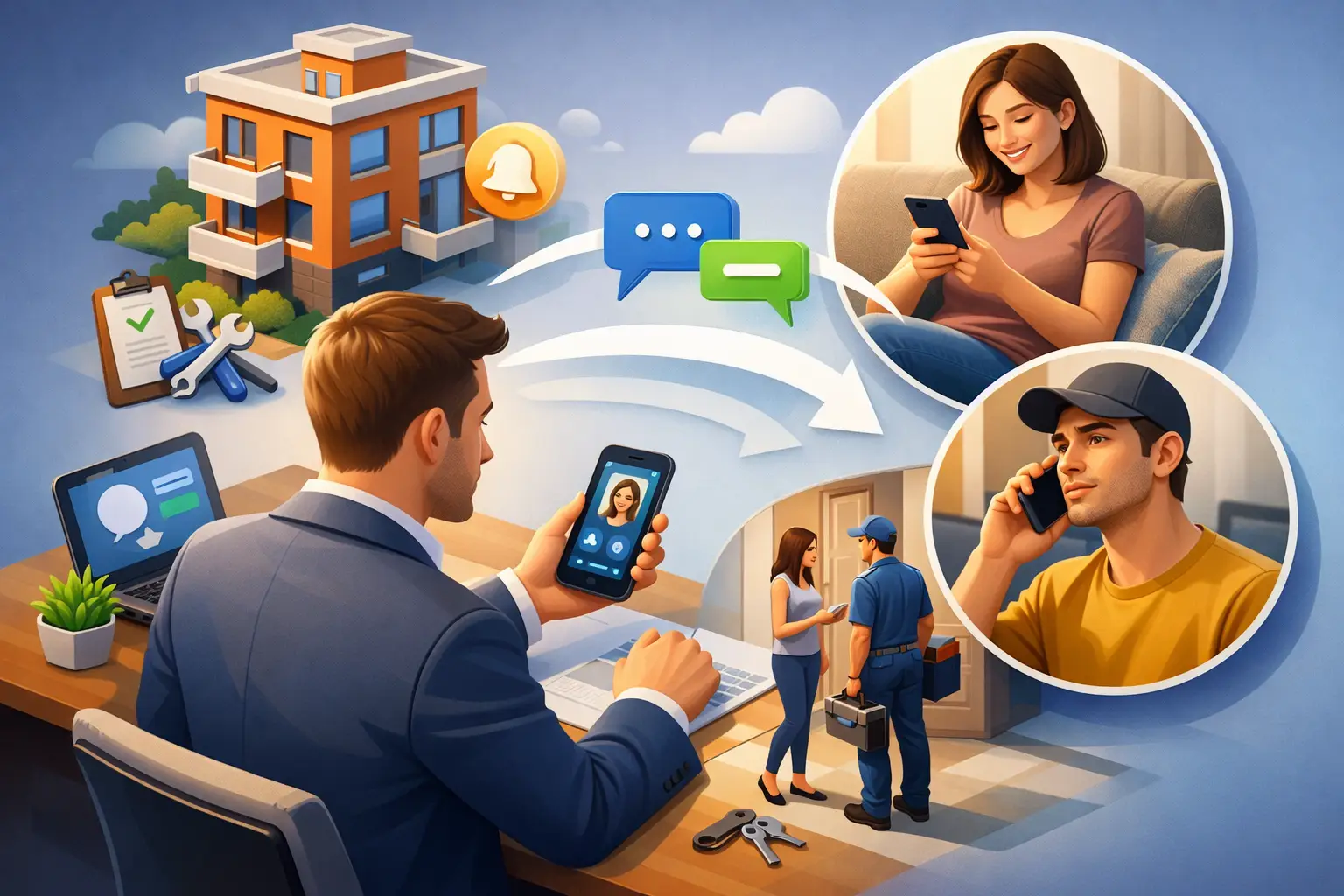
A tenant reports a parking issue by email, asks about visitor access by phone, and follows up on a delivery problem through the front desk. None of those messages live in one place, and now your team is reacting instead of managing. That is usually where the real question starts: how to improve tenant communication when the problem is not effort, but fragmentation.
or office buildings and mixed-use properties, communication is not a soft skill layered on top of operations. It is part of the operating model. If updates are delayed, if channels are inconsistent, or if tenants do not know where to go for answers, small issues become visible signs of poor building management.
Why tenant communication breaks down
Most communication problems are not caused by a lack of messages. They come from too many disconnected ones. Property teams often rely on email for announcements, printed signage for visitors, spreadsheets for contact lists, and ad hoc phone calls for urgent issues. ach tool handles one part of the job, but none gives tenants a clear, predictable experience.
That matters because tenants judge responsiveness in practical terms. They want to know where to park, how to register a guest, what to do during maintenance, and who can solve an issue without being passed around. When those answers are scattered, the building feels harder to use than it should.
The fix is not simply sending more updates. It is creating a communication structure that tenants can trust. Good tenant communication is timely, visible, easy to act on, and consistent across the full building journey.
How to improve tenant communication with fewer channels
If you want to know how to improve tenant communication, start by reducing confusion. Many property teams make the mistake of offering too many contact paths without defining what each one is for. Tenants then choose whatever is easiest in the moment, which creates uneven response times and internal bottlenecks.
A better approach is to create a small number of clear communication lanes. One channel might handle building-wide updates such as maintenance notices, access changes, and emergency alerts. Another can support day-to-day tenant requests, while a third serves visitors and deliveries. The point is not to limit access. The point is to remove guesswork.
This is where digital infrastructure matters. In a modern office building, tenants should be able to access live, current information from a central digital touchpoint rather than relying on old PDs, forwarded emails, or reception staff as the default source of truth. A platform built for office building communication can reduce friction because it turns scattered updates into one active tenant-facing hub. OneContact approaches this through a smart building communication ecosystem designed for property teams and tenant companies in office environments.
Make every update easy to understand
Clarity is usually more valuable than detail. Property managers often know the full context behind an elevator outage, an HVAC issue, or a temporary entrance change. Tenants do not need the whole backstory. They need a simple explanation, a timeframe if available, and a clear next step.
That sounds obvious, but many building updates are written from the manager's point of view instead of the tenant's. A notice that says scheduled service activity will affect access control between 2:00 and 4:00 p.m. is technically correct. It is also less useful than saying the north entrance will be unavailable from 2:00 to 4:00 p.m. and visitors should use the main lobby.
Plain language improves trust because it lowers effort. It also reduces repeat questions, which gives your team more time to handle actual issues instead of clarifying announcements.
Speed matters, but predictability matters more
ast responses are valuable, but tenants notice consistency even more. If one manager replies in ten minutes and another takes two days, the building experience feels unreliable. The same goes for communication timing. If maintenance alerts arrive after tenants have already encountered the issue, the message does not feel helpful.
The stronger model is to set expected communication rhythms. Building-wide notices should follow a standard format. Service disruptions should be shared as early as possible, with updates if timelines change. Tenant requests should trigger acknowledgment quickly, even if the final answer takes longer.
This is an area where technology can improve performance without adding headcount. Automated acknowledgments, centralized updates, and role-based routing help teams respond faster while maintaining a consistent experience. The trade-off is that automation should not feel evasive. If tenants receive instant confirmations but no meaningful follow-up, trust drops. Automation works best when it supports human service, not when it replaces it.
Treat visitor communication as part of tenant communication
One of the most common blind spots in office buildings is separating tenant communication from visitor communication. rom the tenant's perspective, those experiences are connected. If a guest cannot find parking, access the building, or reach the right office, the tenant feels the friction too.
That is why better tenant communication should include visitor instructions, wayfinding, access details, and live building information in the same digital ecosystem. Tenants should not have to rewrite the same arrival instructions every time they host someone. A centralized, mobile-friendly system gives them a better way to guide guests without creating extra work for the management team.
This also improves the perception of the building itself. Clear arrival flows make tenants look organized, and they make property teams look responsive. In competitive office environments, that matters.
Use communication data to find operational weak spots
If the same questions keep appearing, communication may be exposing an operational gap. Repeated requests about deliveries, lobby access, parking validation, or service hours usually signal one of two issues: the information is hard to find, or the process itself is confusing.
This is why communication should not be measured only by response speed. Volume trends, recurring request types, and peak inquiry times can reveal what tenants are actually struggling with. That insight helps property managers improve not just messaging, but building operations.
or example, if visitor access questions spike every Monday morning, the issue may not be tenant awareness. It may be a weak arrival process for start-of-week traffic. If multiple companies ask where to direct couriers, there may be a signage or policy problem. The best communication systems make these patterns visible early.
Personalization helps, but only when it stays useful
Tenants do not all need the same information. A building-wide alert may apply to everyone, but leasing contacts, office administrators, employees, and visitors each need different levels of detail. Segmenting communication by audience can improve relevance and reduce noise.
Still, there is a balance. Over-segmentation creates complexity and increases the risk that people miss important messages. That is why the strongest setup usually combines universal building updates with role-specific layers for tenant contacts, company admins, or operational stakeholders.
In multilingual environments, this becomes even more important. If your building serves international teams, visitors, or regional offices, language accessibility should be part of your communication strategy rather than an afterthought. When building information is available in the user's device language, adoption tends to rise because the experience feels immediate and usable.
Build one source of truth for tenants
The most practical answer to how to improve tenant communication is to stop forcing tenants to search. They should not need to check old emails, call reception, or ask multiple people to find basic building information. One reliable digital source reduces that friction immediately.
That source can include live building announcements, visitor instructions, contact points, navigation details, parking information, office access guidance, and direct communication paths. When those elements are updated in real time, tenants do not have to wonder whether they are looking at outdated information.
This is especially important in buildings where multiple tenant companies operate with different schedules, visitor patterns, and service needs. A static communication model cannot keep up with that complexity. A dynamic one can.
Better communication starts with better design
Tenant communication improves when it is built into the tenant experience, not added as a patch after complaints appear. That means thinking beyond mass emails and asking a sharper question: where do tenants naturally go when they need information right now?
If the answer is nowhere clear, that is the opportunity. A centralized digital communication layer gives property teams a way to organize updates, simplify arrivals, support tenants faster, and create a more professional building experience without multiplying tools.
The goal is not to communicate more. It is to communicate in a way that makes the building easier to use every day. When tenants know where to go, what to expect, and how to get quick answers, operations feel stronger before anyone says a word.