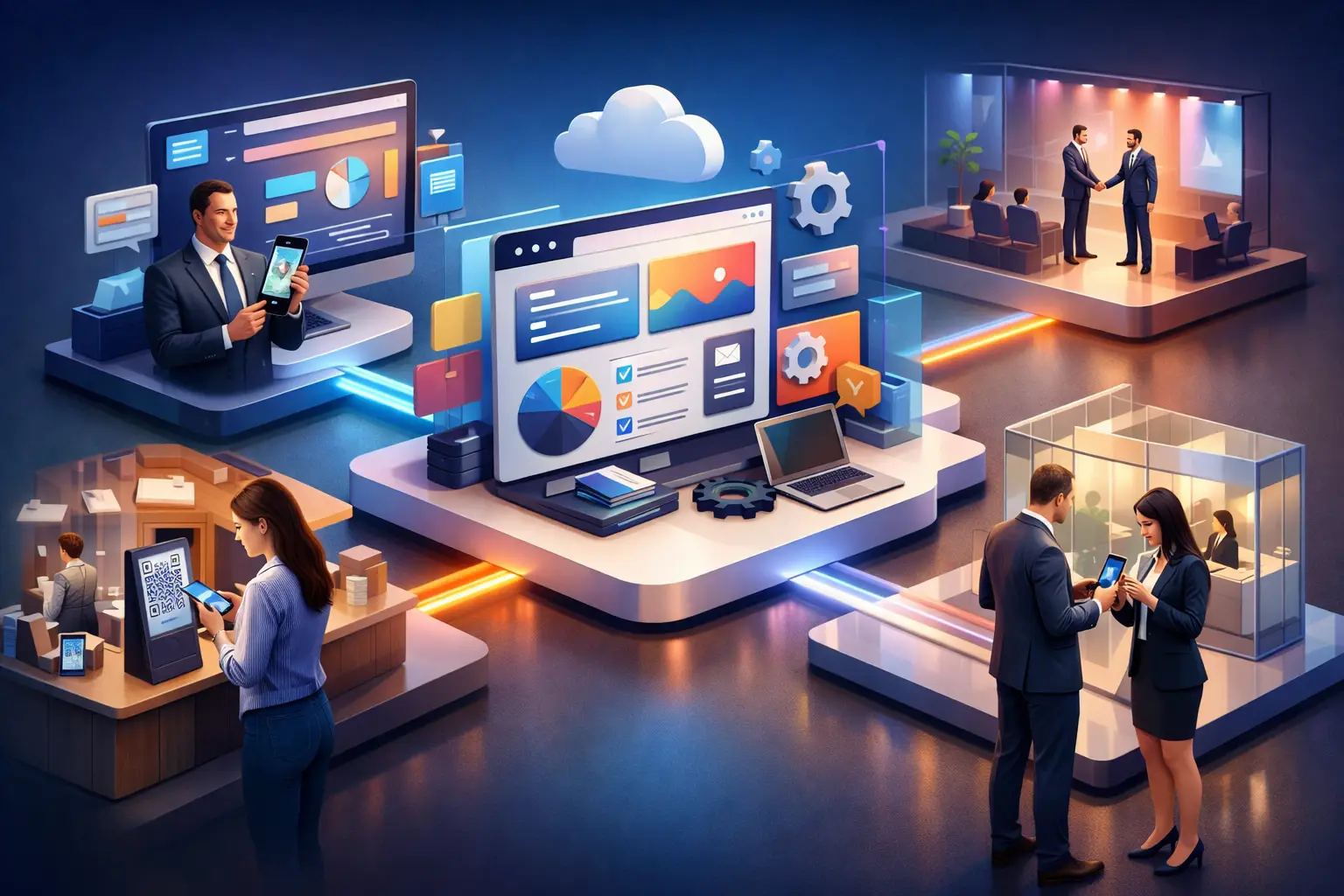
A customer scans a QR code at your front desk, on a business card, or outside your office. What happens next decides whether that moment turns into a booking, a lead, a support request, or nothing at all. A custom digital hub for service businesses gives that scan a clear purpose by turning one interaction into a live, branded path to the next step.
or service providers, that matters more than another static landing page ever could. Most businesses are still sending people through a patchwork of website links, PDs, phone numbers, social profiles, booking tools, and messaging apps. It works just enough to survive, but not well enough to scale. very extra click creates drop-off. very outdated link chips away at trust. very disconnected touchpoint makes your team slower than it needs to be.
What a custom digital hub for service businesses actually does
At a basic level, a digital hub brings your key customer actions into one place. But the useful version is not a generic link page with your logo at the top. A real custom digital hub for service businesses is built around how your customers and teams already interact.
That might mean one scan gives a clinic patient directions, appointment booking, forms, and direct contact with the right department. or a real estate office, it might mean property links, agent details, WhatsApp contact, reviews, and lead routing. or a restaurant group, it could mean reservations, menu access, branch locations, support, and promotions based on language or location.
The difference is context. Service businesses do not need more digital clutter. They need one environment that adjusts to the service moment, the audience, and the location.
Static links create friction you can measure
Most teams do not notice how much business they lose through small delays. A staff member shares one outdated PD. A prospect lands on an Instagram profile instead of a contact flow. A building visitor cannot find parking instructions. An event attendee never reaches the exhibitor follow-up page after the conference ends.
These are not branding issues. They are conversion issues.
When your digital presence is spread across disconnected tools, every update takes longer and every handoff becomes less reliable. Service businesses feel this more than product-led companies because they depend on timing, responsiveness, and trust. A customer is not comparing features on a shelf. They are trying to reach a person, solve a problem, arrive at a location, or make a decision quickly.
That is why live digital assets matter. Instead of reprinting cards, resending links, or manually correcting information, your business can update one centralized hub and keep every customer-facing touchpoint current.
Where customization makes the biggest difference
Not every business needs the same setup, and that is exactly the point. A generic platform usually forces you into generic behavior. A tailored hub lets you organize around the actions that matter most.
Digital identity that stays current
or professionals, executives, sales teams, and client-facing staff, digital identity is often the first conversion point. A paper business card or a static contact page gives people information. A live digital identity gives them options.
With smart QR business cards and digital identity tools, a contact can save details, open social channels, reach a booking link, view company information, or take immediate action from one scan. That is especially useful when your team works across languages, locations, or service lines.
The trade-off is simple. If your business only needs a name and phone number online, a custom setup may feel like more than you need. But if your staff depends on networking, referrals, repeat contact, or fast lead capture, a dynamic identity layer usually pays for itself in speed and consistency.
vents that do more than manage attendance
Service businesses often treat events as one-off campaigns, but conferences, industry meetups, and hosted client events are lead environments. If registration, engagement, and follow-up happen in separate systems, the attendee experience gets messy and the sales team loses context.
A centralized event experience changes that. With a platform built for conferences and events, organizers can manage registration, participation, and attendee interaction in one place. xhibitors can capture leads without relying on disconnected tools. Attendees get a clearer experience without downloading a generic app they will never use again.
This matters even for businesses that are not full-time event operators. If you regularly host seminars, networking evenings, open houses, or customer education sessions, your event flow should connect directly to your sales and service goals.
Office buildings and service access in one flow
or property managers, tenant companies, and businesses operating in commercial spaces, the customer journey starts before the meeting. Visitors need directions. Tenants need updates. Staff need a central communication layer that is easier than chasing emails and printed notices.
A digital ecosystem for office buildings and building management gives teams a practical way to handle navigation, parking info, office contact, and building communication through one accessible interface. That improves the visitor experience, but it also reduces operational noise for internal teams.
The right setup depends on traffic volume and complexity. A small office may only need visitor guidance and tenant contact. A larger property may need a broader communication structure across management, tenants, and guests. The platform should fit that reality, not force every building into the same model.
Why service businesses benefit more than generic brands
Service businesses win or lose on responsiveness. Customers are not just browsing. They are trying to act. They want to schedule, contact, confirm, arrive, ask, or decide with minimal effort.
That is why a custom hub performs better than a standard website menu in many situations. It shortens the path between intent and action. It also gives your business more control over what happens after a scan, a click, or an introduction.
There is also a language and accessibility advantage. If you serve diverse audiences, international visitors, or mixed-language customer bases, automatic language detection and multilingual delivery can remove a lot of silent friction. People engage more when the experience meets them where they are.
What to look for before you choose a platform
A platform should not impress you with features you will never use. It should solve the delays and disconnects your business deals with every day.
Start with three questions. irst, where are customers dropping off right now - before contact, during booking, at arrival, or after the first interaction? Second, which teams are using too many separate tools to manage one customer journey? Third, what information changes often enough that static links are already a liability?
If you can answer those clearly, the right platform choice becomes easier.
Look for customization at the workflow level, not just the design level. A branded page is useful, but branded logic is better. Your hub should reflect how leads are captured, how departments are reached, how visitors are guided, and how follow-up happens. It should also give you room to adapt by audience, location, or use case.
OneContact approaches this well because it is not built as a generic app trying to fit every problem. It is structured around distinct business contexts - digital identity, events, and office buildings - which makes adoption more practical for teams that need a solution tied to a real use case.
The business case is simpler than it sounds
You do not need a major transformation project to justify a custom hub. In many service environments, the return starts with small operational wins. ewer missed inquiries. aster contact routing. Better event lead capture. Less confusion for visitors. More useful scans from business cards and physical signage.
Over time, those small gains add up to something bigger: a business that feels easier to reach, easier to trust, and easier to buy from.
That is the real value here. A custom digital hub is not another channel to manage. It is the structure behind your customer interactions. And when that structure is current, centralized, and built around actual service moments, every touchpoint has a better chance of becoming an opportunity.