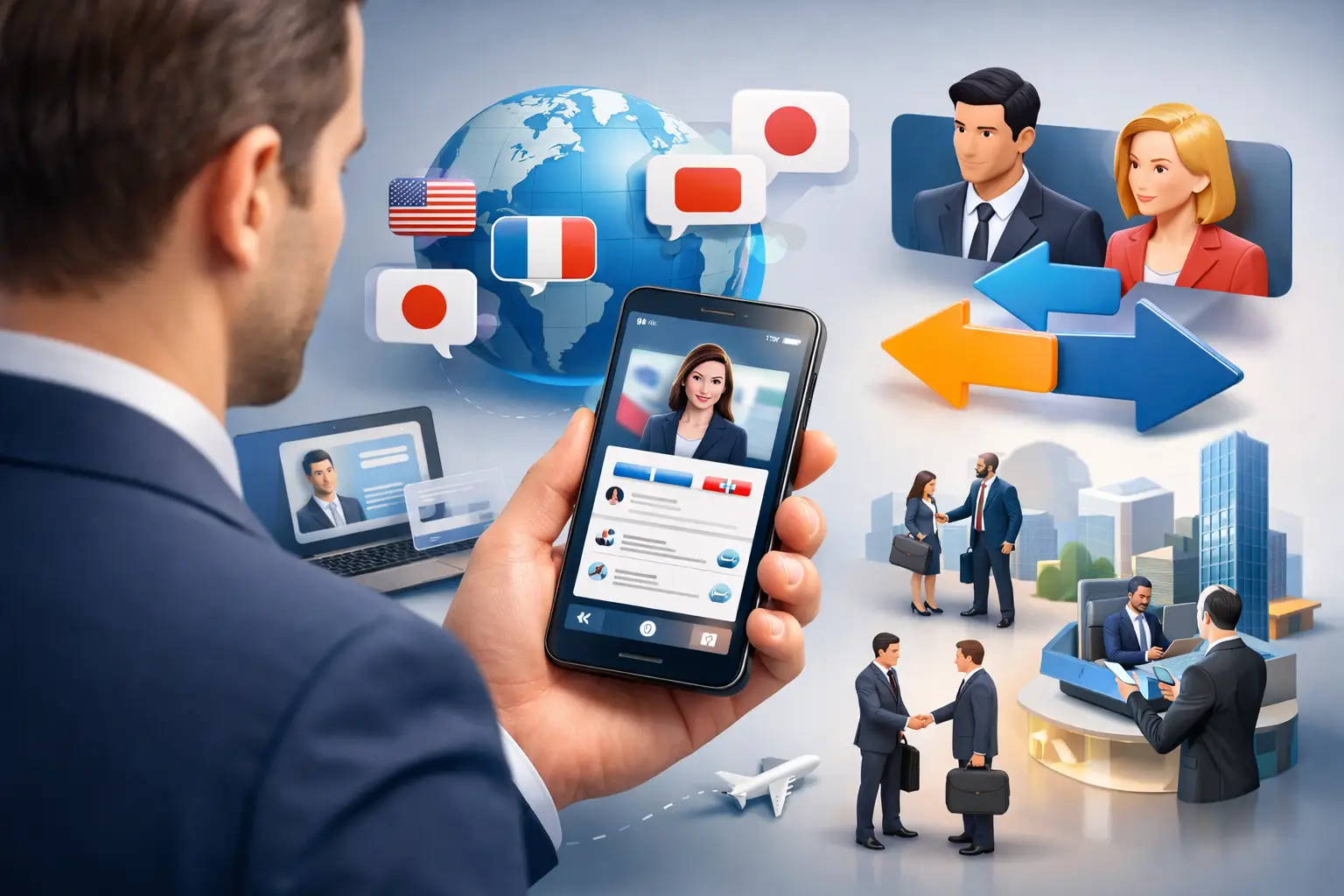
A customer scans your QR code in a lobby, at a booth, or from a printed sign. If the page opens in the wrong language, you lose a few seconds. Sometimes that is all it takes to lose the lead.
That is why an auto-translate business profile matters. It removes a small but expensive layer of friction by showing people the right language the moment they land on your profile. or companies that meet customers across offices, events, retail spaces, and digital channels, that change is not cosmetic. It directly affects response rates, trust, and conversion.
What an auto-translate business profile actually does
At a basic level, an auto-translate business profile detects the visitor's device language and displays your profile in that language automatically. The best setups do this instantly, without asking the user to hunt for a language toggle or restart the experience.
That sounds simple, but the business impact is bigger than it looks. A profile is often where people decide what to do next. They call, book, message, ask for directions, save contact details, or leave without taking any action. If the page feels unfamiliar or confusing, even for a moment, your conversion path gets weaker.
This matters even more when the profile is not just a digital brochure. A modern business profile can include live contact details, booking links, social channels, support options, lead capture, maps, and product or service information. The more useful the profile becomes, the more important language clarity becomes too.
Why auto-translate business profile features improve conversion
Most companies think about translation as a content issue. In practice, it is a user journey issue.
When someone opens a profile in their own language, they understand faster and act faster. That affects every stage of the interaction. A visitor in an office building can find parking, floor details, or a direct office contact without asking the front desk. An event attendee can understand booth information and send their details without awkward back-and-forth. A potential customer can book a service or message your team without second-guessing what the buttons mean.
There is also a credibility factor. Businesses that present themselves clearly in multiple languages feel more prepared, more inclusive, and more professional. That is especially true for organizations operating in international markets or mixed-language environments. If your business serves tourists, global attendees, multinational tenants, or cross-border clients, a single-language profile sends the wrong signal.
Still, auto-translation is not magic. It works best when the underlying profile is structured well. Short labels, clear calls to action, clean navigation, and updated information give translation tools less room for error and visitors less room for hesitation.
Where an auto-translate business profile makes the biggest difference
The value shows up fastest in high-intent environments - places where someone is already close to taking action.
vents and conferences
At events, speed matters. Attendees scan first and decide later. If your business profile opens in their language, they can understand your offer, save your contact details, and submit interest on the spot. That is especially useful for exhibitors who want better lead capture without forcing visitors into a generic app flow. or organizations managing event registration and engagement, a connected platform for conferences and events can make that interaction far more useful across languages: Conferences & Events
Office buildings and tenant communication
Buildings are full of micro-interactions that break down when the information is unclear. Visitors need directions, parking details, office access instructions, and a fast way to contact the right person. Tenants need a smarter communication layer that works for employees, guests, and service providers. In that setting, auto-translation is not a nice extra. It reduces confusion at the point of arrival. A digital building communication setup can support that experience in a more organized way: Office Buildings
Smart digital identity and QR-based sharing
or professionals, executives, and service providers, a profile often replaces the old business card. But a paper card never had to explain itself in multiple languages. A digital identity page does. If your profile is shared by QR code, text message, email signature, or social bio, it needs to make sense immediately to different audiences. That is where a smart digital identity solution becomes more than a design upgrade. It becomes a conversion tool: Your Digital Identity
What to look for in an auto-translate business profile platform
Not every translation feature is worth using. Some tools simply add a language menu and call it global readiness. That is better than nothing, but it still asks the visitor to do extra work.
A stronger setup starts with automatic device-language detection. The profile should open in the language the visitor expects, with the option to switch manually if needed. That balance matters because device settings are usually right, but not always.
You also want live profile management. If your business hours, team contacts, event details, or service links change, those updates should appear everywhere instantly. Translation is much more valuable when it sits inside a dynamic profile rather than a static page.
The next factor is channel flexibility. A business profile should work the same way whether it is accessed from a QR code, a direct link, a badge, a booth display, a reception desk, or a printed card. If the multilingual experience breaks across channels, your results will be uneven.
inally, think beyond translation itself. The real goal is action. Can visitors call, message, navigate, register, save contact details, or submit their information in a clear flow? If not, the profile may be multilingual but still underperform.
The trade-offs to consider
An auto-translate business profile solves a real problem, but it still requires judgment.
The first trade-off is control versus speed. ully automated translation is fast and scalable, which is ideal for growing organizations. But if your business relies on legal wording, highly technical product language, or nuanced brand messaging, you may want manual review for core sections.
The second is depth versus simplicity. Some companies try to include every possible link, form, and content block in one profile. That can make translation harder and the user experience slower. In many cases, a shorter profile with the right actions performs better than a crowded one in eight languages.
The third is broad reach versus audience fit. Not every business needs the same number of languages or the same kind of multilingual flow. A local clinic in one market has different needs than a multinational exhibitor team or a commercial office complex with international visitors. The right setup depends on who scans, where they scan, and what you want them to do next.
Why this matters now for growth-focused teams
Businesses have already accepted that first impressions are digital. The next shift is realizing that first impressions are also language-sensitive.
If your customer journey starts with a profile, then that profile needs to do more than look polished. It needs to recognize the visitor, reduce friction, and move them toward action in real time. That is true whether the interaction starts at a front desk, on a trade show floor, in a tenant lobby, or from a shared contact card.
or teams trying to centralize scattered links, modernize in-person engagement, and make every scan measurable, an auto-translate business profile is a practical upgrade with visible payoff. It helps your business feel easier to approach, faster to understand, and better prepared for the markets you already serve.
OneContact builds for exactly that kind of interaction - where digital identity, event engagement, and physical spaces all need to work as one system instead of disconnected tools.