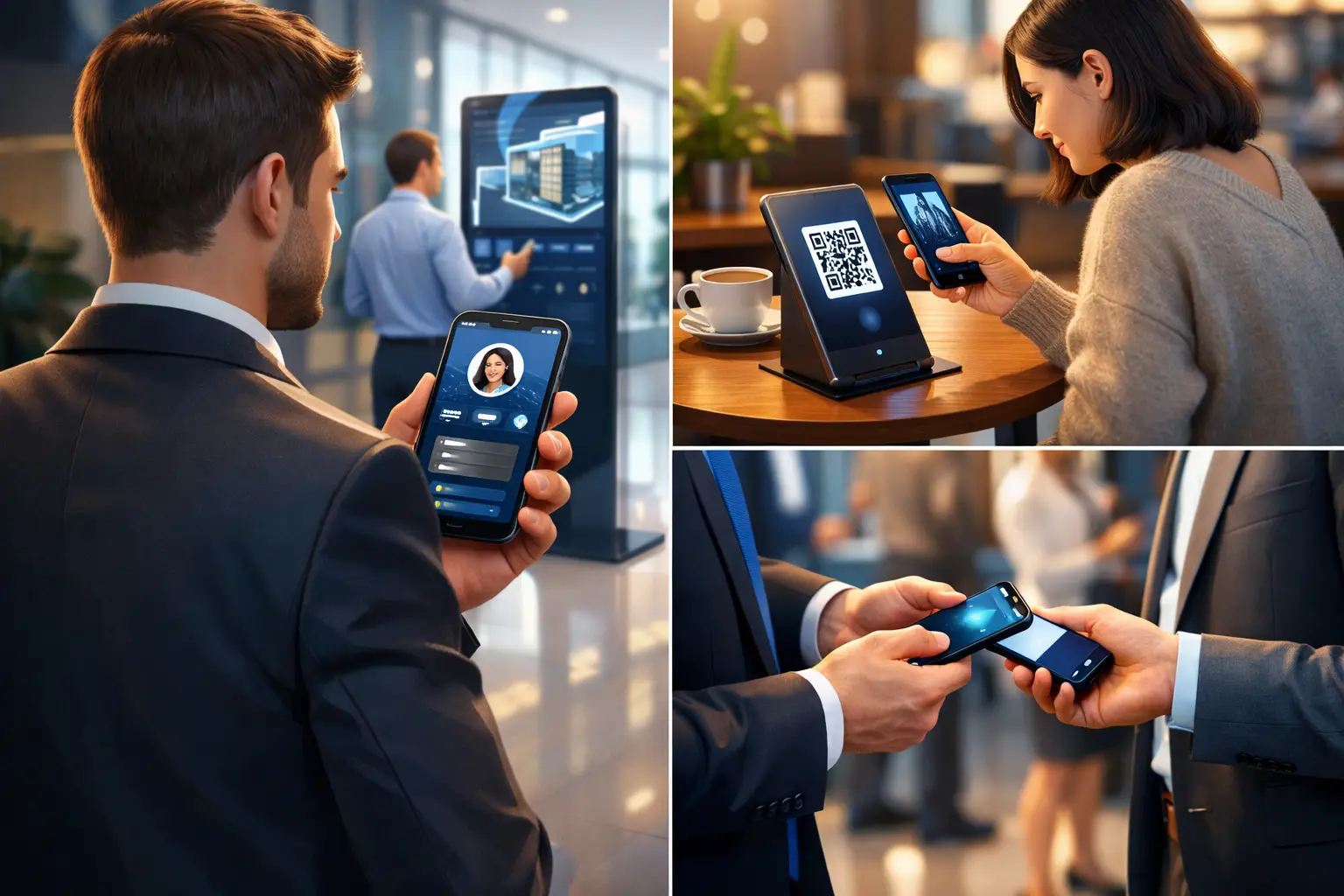
A customer scans a QR code at your booth, front desk, or storefront. If the next step is a dead PD, a generic homepage, or a long list of links, the moment is already slipping away. That is the real question behind אפליקציה לעסק - not whether your company should have an app, but whether the digital experience you offer turns interest into action.
or many organizations, the old answer was simple: build an app. Today, that answer is often too expensive, too slow, and too broad. Most businesses do not need a generic mobile app sitting in an app store. They need a live digital touchpoint that works instantly, updates in real time, and fits the exact context of the interaction.
What decision-makers really mean by אפליקציה לעסק
When companies say they want an app, they are usually describing a business problem, not a technical requirement. They want customers to book faster. They want visitors to find the right office without calling reception. They want conference attendees to register, engage, and exchange details without friction. They want a sales contact shared in one second, not lost in a paper card exchange.
That distinction matters. A traditional app can solve those problems, but it can also create new ones. Users may need to download it, update it, learn it, and keep it on their phone for an interaction that lasts two minutes. If the value is not immediate, adoption drops fast.
A smarter approach starts with the interaction itself. What does the user need right now? Contact details, directions, registration, support, booking, exhibitor information, parking instructions, or a fast way to continue the conversation? Once that is clear, the format becomes easier to choose.
When אפליקציה לעסק is the right move
A dedicated app makes sense when people need repeated use, personalized access, and deeper functionality over time. If your users log in regularly, manage ongoing tasks, receive role-based content, or depend on advanced workflows, a full app can be worth the investment.
This is common in businesses with high-frequency engagement. Tenant communication inside an office building is a good example. If occupants need updates, navigation, visitor coordination, parking details, and direct building communication as part of daily operations, a structured digital environment is valuable. The same applies to event platforms that support registration, attendee participation, exhibitor engagement, and lead capture across the full conference lifecycle.
ven then, the best business app strategy is usually not “build one giant app and hope everyone uses it.” It is to create a focused digital hub around specific use cases. That is where many companies get better results. They stop forcing every audience into the same experience and start matching the experience to the moment.
When a business app adds more friction than value
This is the part many vendors skip. Sometimes an app is simply too much.
If the interaction is lightweight, occasional, or guest-based, requiring a download often hurts conversion. A restaurant guest who wants a menu, a clinic visitor who needs directions, a prospect at a booth who wants your details, or a visitor entering a building for the first time does not want to commit to an app. They want an immediate next step.
That is why static link pages and app-first thinking often underperform in real business environments. They are built around the company’s internal structure instead of the user’s immediate need.
In those cases, a dynamic mobile-friendly experience is often stronger than a downloadable app. It loads fast, can be shared by QR, adapts by device language, and can be updated without asking the user to do anything. That makes it easier to maintain and far easier to adopt.
A better model: one platform, different business outcomes
The strongest digital strategies today are modular. Instead of treating אפליקציה לעסק as a single product decision, they treat it as a business engagement system.
or professionals, executives, and public-facing teams, the priority is often digital identity. A smart digital card works better than a paper card and better than a scattered list of social links because it creates one live destination for contact, content, scheduling, and follow-up. It is fast to share and easy to update. More important, it turns a brief introduction into an active opportunity.
or event organizers and exhibitors, the challenge is different. The goal is not just information sharing. It is participation, networking, and measurable lead capture. That requires real-time engagement tools, registration flows, and attendee interactions that do not break under pressure during live events.
or office buildings and tenant environments, the need is operational clarity. Visitors need directions. Tenants need communication. Property teams need a digital layer that supports the building experience instead of relying on disconnected signs, emails, and manual processes.
These are not the same problem. They should not be forced into the same generic app.
What to look for instead of asking, “Do we need an app?”
A better buying question is this: what digital action do we want the user to take, and how fast can they take it?
If your current setup depends on static pages, paper materials, or too many disconnected tools, start there. Look for a solution that keeps content live, accessible, and context-specific. The best platforms reduce steps, not add them.
That means real-time updates matter. So does language adaptation, especially for businesses serving international audiences. If a prospect, attendee, or visitor can access the right information instantly in the language of their device, response rates improve and support friction drops.
Customization matters too, but not in the old sense of endless feature bloat. What matters is whether the experience can be tailored to the audience. A tenant company needs a different flow than a conference attendee. A CO sharing a digital identity needs a different structure than a retail business collecting reviews and bookings.
How to evaluate an אפליקציה לעסק without overbuilding
Start by mapping three things: the user, the moment, and the conversion goal.
The user could be a customer, visitor, attendee, tenant, exhibitor, or business contact. The moment could be arrival, registration, networking, discovery, support, or follow-up. The conversion goal could be a booked meeting, a saved contact, a completed registration, a lead captured in CRM, or a successful building arrival.
Once those three are clear, the technical shape becomes much easier to define. Some organizations will need a richer app-like environment. Others will need a QR-driven digital hub that behaves like a smart app experience without the download barrier.
This is where a platform approach is usually stronger than custom development from scratch. It gives businesses speed, flexibility, and easier maintenance while still supporting different vertical needs.
OneContact is a good example of this shift. Instead of pushing one generic app for every use case, it supports digital identity, conferences and events, and office building communication through tailored digital experiences built on one adaptable platform.
The practical test: does it create momentum?
very business tool should be judged by momentum. Does it move the user forward immediately, or does it ask them to pause, search, install, and figure things out?
A strong digital identity experience should help someone save your details and contact you in seconds. A strong event experience should help attendees register, connect, and engage while giving organizers and exhibitors measurable outcomes. A strong building experience should reduce confusion and improve access from the moment a visitor arrives.
If your version of אפליקציה לעסק does not create that momentum, the format is probably wrong, even if the technology looks impressive.
That is why more businesses are moving away from the outdated idea that every serious company needs a standalone app. What they actually need is an always-available digital layer across their real-world interactions.
The smartest business app may not look like an app
This is the shift worth paying attention to. Business interaction is no longer limited to websites on one side and app stores on the other. There is a growing middle ground: live, mobile-first digital experiences designed for a specific business context.
That approach is often faster to launch, easier to update, and easier for users to adopt. It also fits how people behave in the real world. They scan, tap, compare, register, and move on. The companies that win are the ones that remove delay from those moments.
So if you are considering אפליקציה לעסק, do not start with the app. Start with the interaction. Build the shortest path between interest and action, and make sure it stays live long after the first scan.